Slash commands
The author-facing surface. Each command dispatches into the muse, a skill, or the engine; none of them hides a gate.
| Command | Purpose |
|---|---|
| /vellum:init | Set up a novel project. Set up a creative-writing project for this plugin — run the project-setup skill (interview, kb layout, CLAUDE.md, initial state rebuild). |
| /vellum:write-chapter | Write a chapter. Run the chapter loop — outline, author approval, draft, critique, acceptance, capture. |
| /vellum:status | State card & gate status. Print the state card, gate statuses, and open findings summary. |
| /vellum:cold-read | Cold read. Set up work/cold-reads/<YYYY-MM> from templates/cold-read and run cold-read batches. |
| /vellum:retune | Retune the voice. Run the voice retune protocol from a raw author sample. |
| /vellum:export | Export the manuscript. Evaluate readiness, then build the export bundle. |
| /vellum:dismiss | Dismiss a finding. Record an author dismissal of a finding as an exemption (requires the reason in the author own words). |
| /vellum:series | Operate the series layer. Operate the library/series layer — link books, capture series canon, run retcon checks, plan and apply retcons. |
Agents
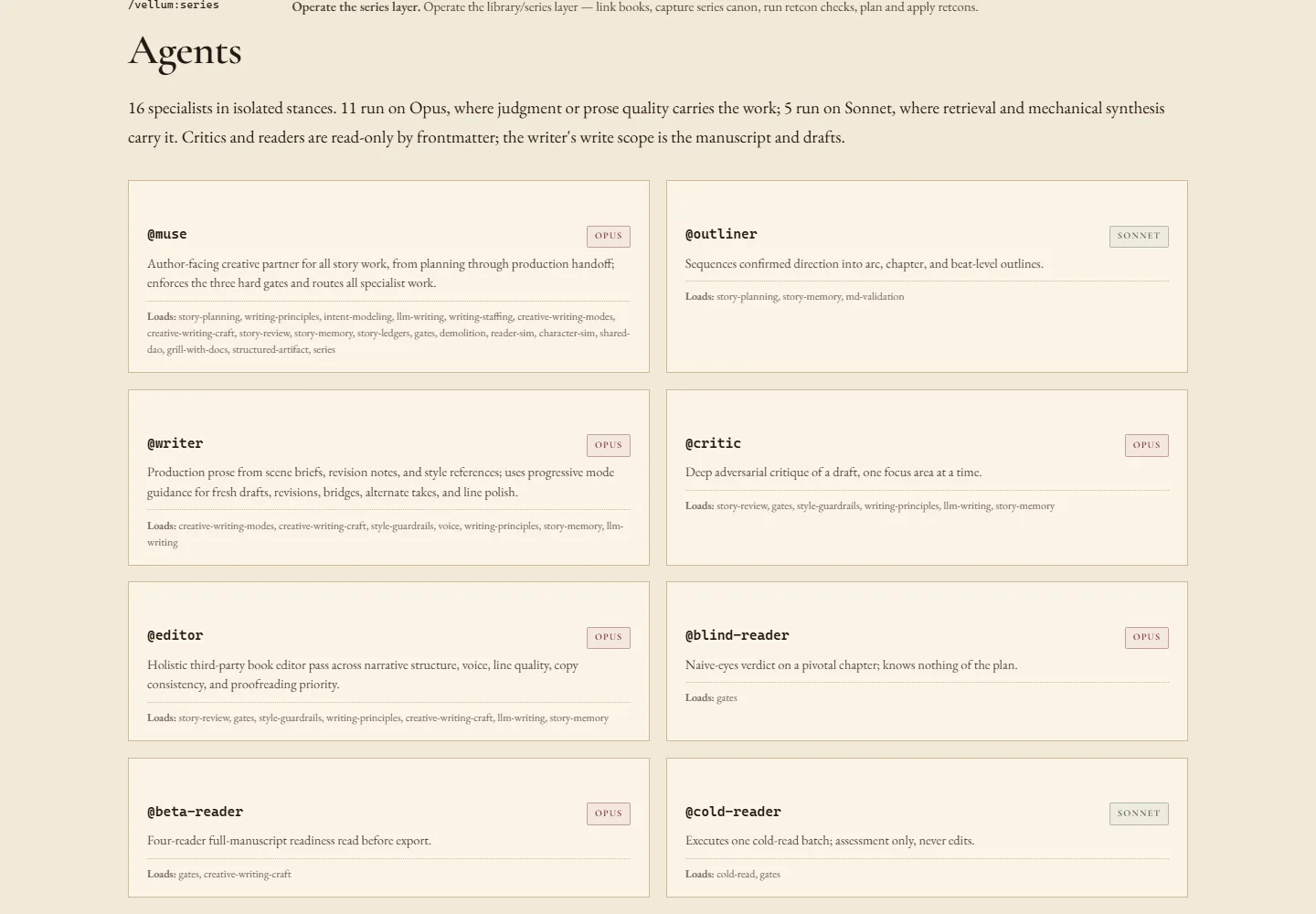
16 specialists in isolated stances. 11 run on Opus, where judgment or prose quality carries the work; 5 run on Sonnet, where retrieval and mechanical synthesis carry it. Critics and readers are read-only by frontmatter; the writer's write scope is the manuscript and drafts.
@muse
opusAuthor-facing creative partner for all story work, from planning through production handoff; enforces the three hard gates and routes all specialist work.
Loads: story-planning, writing-principles, intent-modeling, llm-writing, writing-staffing, creative-writing-modes, creative-writing-craft, story-review, story-memory, story-ledgers, gates, demolition, reader-sim, character-sim, shared-dao, grill-with-docs, structured-artifact, series
@outliner
sonnetSequences confirmed direction into arc, chapter, and beat-level outlines.
Loads: story-planning, story-memory, md-validation
@writer
opusProduction prose from scene briefs, revision notes, and style references; uses progressive mode guidance for fresh drafts, revisions, bridges, alternate takes, and line polish.
Loads: creative-writing-modes, creative-writing-craft, style-guardrails, voice, writing-principles, story-memory, llm-writing
@critic
opusDeep adversarial critique of a draft, one focus area at a time.
Loads: story-review, gates, style-guardrails, writing-principles, llm-writing, story-memory
@editor
opusHolistic third-party book editor pass across narrative structure, voice, line quality, copy consistency, and proofreading priority.
Loads: story-review, gates, style-guardrails, writing-principles, creative-writing-craft, llm-writing, story-memory
@blind-reader
opusNaive-eyes verdict on a pivotal chapter; knows nothing of the plan.
Loads: gates
@beta-reader
opusFour-reader full-manuscript readiness read before export.
Loads: gates, creative-writing-craft
@cold-reader
sonnetExecutes one cold-read batch; assessment only, never edits.
Loads: cold-read, gates
@continuity-checker
sonnetCross-references content against established canon for contradictions.
Loads: story-review, md-validation, shared-dao, story-memory
@character-sim
opusIn-character conversation for voice discovery and relationship testing.
Loads: character-sim, writing-principles, llm-writing, story-memory
@reader-sim
opusExperiential reader response from a caller-specified reader persona; pass the persona, draft, and knowledge boundary.
Loads: reader-sim, writing-principles, llm-writing
@disruptor
opusControlled-wildness proposals for flat chapters; proposal-only.
Loads: creative-writing-craft, story-planning
@brainstormer
opusCreative option generation for a scoped question or angle.
Loads: story-planning, story-memory, intent-modeling, llm-writing
@style-creator
opusAnalyzes prose samples to produce style reference files for the project's voice.
Loads: creative-writing-craft, style-guardrails, voice, writing-principles, llm-writing, story-memory
@kb-lead
sonnetKnowledge-capture worker; writes only under kb/ and runs engine checks after updates.
Loads: story-memory, story-ledgers, series, series-bible
@web-researcher
sonnetWeb research for fiction — primary sources, reference works, cultural detail, domain expertise, and community discussion.
Loads: creative-research
Skills
34 skills carry the methodology. They are loaded on demand, so a specialist gets the craft, schemas, or rubric it needs without carrying the rest.
Drafting & craft 8
The how-to-write layer: prose technique, production modes, reader simulation, and the craft corpus the writer loads on demand.
creative-writing-craft
Craft references for writing fiction well: prose, scenes, style, voice, and genre/page-level technique. Load when a writer, critic, or muse needs how-to-write guidance rather than a production mode.
creative-writing-modes
Creative-writing addendum to /llm-writing. Load when putting prose on the page: draft, revise, bridge, vary, or polish.
creative-writing-muse
Load when no subagents are available and one agent must plan, draft, critique, research, and capture memory by switching stances.
llm-writing
Load before writing or revising human-facing text. Choose words deliberately, ground the piece in the reader's context, and remove default LLM phrasing before the final draft.
writing-principles
What fiction readers want (reader reward channels) and the specific ways LLM training damages them. Load when drafting prose, critiquing, or diagnosing why a passage feels flat.
writing-staffing
Dispatch reference for composing writing teams. Teaches which skills to load for each subagent, which resources to reference, and when to fan out versus run parallel lanes. Load when staffing a workflow.
character-sim
Speak as a specified character from their current knowledge, voice, and emotional state. Use for skill-only workflows that need in-character conversation, voice discovery, or relationship pressure tests.
reader-sim
Read as a specified first-time reader persona and report the felt experience. Use for skill-only workflows when a draft needs persona-bound reader-response signal instead of analytical critique.
Planning & review 5
Structure before prose, and the adversarial passes that earn their keep.
story-planning
Planning work before prose: creative direction, story-planning, outlining, and story architecture. Load when deciding what should happen or how a story should be structured.
story-review
Review work after prose exists: editorial review, craft critique, continuity/voice review, copyediting, proofreading, and synthesis of reader-sim signal. Load when diagnosing a draft rather than rewriting it.
demolition
Load when the author invokes demolition on a chapter draft, or when muse offers it before marking a chapter final. The demolition skill is hostile critical analysis applied to fiction: it finds every vulnerability in a chapter — one at a time, never softened, no solutions during demolition — and logs each resolved/deferred/accepted issue in the chapter's Demolition Log. It is the strongest pre-final check; the author may decline it, and declining is recorded.
grill-with-docs
Use when challenging a plan — grills the author against documented decisions and sharpens terminology.
zoom-out
Use when orienting in an unfamiliar area — fans out exploration across structure, knowledge, and history, then synthesizes one orientation map.
Memory & canon 9
The knowledge base, its ledgers, and the rules for keeping it honest.
kb-management
Maintaining the story knowledge base: creating, updating, and organizing wiki-style reference pages in kb/. Use when capturing finalized story knowledge, updating character profiles, documenting world mechanics, or restructuring the kb.
kb-integrity
Load when a vellum check failed, or when muse routes integrity work. The kb-integrity skill teaches how to run the deterministic engine (bible validate, ledger check, wordcount, state check, knowledge --as-of), interpret their findings, apply the exemption protocol, and repair derived files. It is the operator's manual for the mechanical half of the continuity layer — the cold read and the critics find what these linters cannot.
knowledge-layers
Use when deciding where knowledge goes or reading/writing durable docs: AGENTS.md, .context/, KB, docs/, and work directories.
story-ledgers
Load when planning chapters, capturing what a chapter changed, or answering what is still open or who knows what. The story-ledgers skill owns the deterministic continuity layer: the ledger file schemas (promises, questions, knowledge, props, characters, clock), the fixed-section state card, and the chapter-transaction close-out. It is the reference the engine's ledger/bible/wordcount checks validate against — and the source the state card is derived from.
story-memory
Creative-writing domain knowledge for durable story state. Load when preserving or retrieving project memory — fact extraction, context scoping, reference writing, artifact layout, and issue tracking. If you are a knowledge agent such as kb-lead, load this for the fiction-specific categories and conventions your general methodology doesn't cover.
shared-dao
Shared vocabulary for creative writing projects. Load when establishing canonical story terms, resolving ambiguous names, checking term consistency, or deciding where vocabulary belongs in kb/.
information-hierarchy
Load for large human-facing outputs: reports, docs, multi-section explanations, artifacts. Choose the right form for each beat (prose, diagram, table, mockup) and put the answer first, depth behind it. If the medium allows, use progressive disclosure.
qi-layer
Use when writing or maintaining AGENTS.md, .context/CONTEXT.md, or CLAUDE.md mirrors: keep intent docs minimal and load-bearing.
intent-modeling
Use before acting on human instructions: separate what they said from what they meant.
Voice & style 2
The author's measured voice, and the guardrails that never flatten it.
voice
Load for project-setup voice capture, every drift_interval chapters, or when the author says the prose does not sound like them. The voice skill owns the voice lifecycle: capture, measured profile, exemplars/anti-exemplars, drift checks, the blind-tag falsification test, and retune. It is the strongest signal the style-creator and critics have — and the reference the mechanical net defers to.
style-guardrails
Load for the writer and critics before drafting or critiquing prose; also drives the post-write net. The fiction-specific anti-slop reference: tiered word tables, structural caps, smell tests, and the carve-out filter that keeps the mechanical net from flattening voice. Load whenever prose is being produced, reviewed, or scored.
Gates, readers & production 7
The three hard gates, the cover-to-cover read, setup, and export.
gates
Load when muse accepts a pivotal chapter, before export, or for any scoring task. The gates skill owns the shared quality rubric, the export-readiness checklist, the shared finding schema, and the numeric genre profiles. Every critic and gate-owning agent loads this so verdicts are consistent and criteria are referenced, never invented per-agent.
cold-read
Load for /vellum:cold-read, after every major editorial program, and before export. The cold-read skill owns the cover-to-cover cold-read protocol: the reader charter, the rolling ledger, the append-only issue log, and the batching/orchestration model. It finds the accumulating-memory defect classes (clock drift, cross-chapter state contradictions, prop custody, promise bookkeeping, knowledge-state slips) that no scanner, chapter reviewer, or continuity query can see.
project-setup
One-time project setup for creative writing. Interviews you about your project, collects writing samples, proposes kb structure, and creates CLAUDE.md with project conventions.
export
Load for /vellum:export. The export skill is the operator's manual for building the final manuscript: it runs the readiness gate, interprets a failure as a prioritized fix list, runs the deterministic build on PASS, and explains the manifest and the pandoc fallback. The engine implementation lives in scripts/vellum_lib/export.py (Workstream B); this skill is what the operator (muse) follows.
md-validation
Use when validating markdown links or Mermaid diagrams.
structured-artifact
Load when building a static HTML artifact — single page or multi-page site — to make structured information explorable through layout and navigation.
reflect
User-invoked pause before reporting to check intent vs literal completion, surface adjacent wins, and route knowledge capture.
Series layer 2
Optional multi-book canon: the operator's manual and its data dialect.
series
Load for any series-layer workflow: linking a book to a library, bootstrap and retcon lifecycle, the retcon detection catalog, the do-not-re-explain register, handoff generation, and the series state card. Owns the `library` subcommand dispatch surface (§8) and is the operator's manual for the series layer. Does NOT add a fourth gate; findings are advisory-only.
series-bible
Schemas and conventions for the series bible (`series/bible.json`) and the rest of the library layer's JSON state, plus how book kb maintenance maps onto series canon. Load when inspecting or planning changes to bible entities and fields, deciding between a `value` and a `by-book` encoding, setting `scope` or `iron`, resolving what a field's effective value is at a given book ordinal, choosing or checking `series-id:` join keys on kb entity frontmatter, routing captured story knowledge into series scope, or writing kb pages about series-shared characters, props, promises, questions, and world knowledge. Use alongside the series skill, which owns the `library` command surface; this skill owns the data dialect. Findings are advisory-only — the series layer never adds a fourth gate.
Research 1
Factual grounding the writer does not have to invent.
creative-research
Load when a story needs factual grounding the writer doesn't have: historical detail, cultural texture, domain accuracy, or how other authors handled similar material. Pass the question and story context; returns a sourced report the writer can draw from.
Hooks
Seven scripts across six lifecycle events. Only the two outline-gate paths block by default.
| Event | Matcher | Script | Mode |
|---|---|---|---|
| PreToolUse | Write | Edit | MultiEdit | guard-outline-before-prose.sh |
Blocking |
| PreToolUse | Bash | guard-bash-prose-writes.sh |
Blocking |
| PostToolUse | Write | Edit | MultiEdit | check-prose-after-write.sh |
Advisory |
| SessionStart | startup | resume | clear | compact | session-start.sh |
Advisory |
| PreCompact | — | pre-compact.sh |
Advisory |
| Stop | — | session-stop.sh |
Opt-in gate |
| SubagentStop | writer | chapter-maintenance.sh |
Advisory |